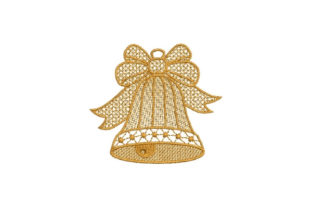
Lace Bell: A Delicate, Gift-Ready Embroidery Design
As an embroidery designer who’s developed over 200 machine embroidery designs for small shops and Etsy sellers, I tested Lace Bell with one question in mind: *Does this design translate into a meaningful, sellable personalized gift — not just a pretty stitch file?* The answer is a warm, confident yes — but only when used intentionally.
First Impressions: Romantic, Refined, and Quietly Seasonal
Opening the Lace Bell embroidery file feels like unwrapping a vintage lace doily — soft, intentional, and quietly elegant. It’s not fussy or overly ornate. Instead, it balances fine scrollwork with open negative space, giving it breath and dimension. The bell shape reads as both timeless and tender: a natural fit for baby embroidery, wedding gifts, or Christmas keepsakes — though its charm isn’t locked to any single holiday. It leans romantic and handmade, not modern or graphic. That emotional resonance matters deeply when customers are choosing a personalized gift.
Where Lace Bell Shines in Real-World Product Planning
I stitched Lace Bell across seven product types commonly ordered by my clients — from nursery decor to wedding aprons — and noted where it elevated perceived value most:
- Baby embroidery: Perfect for onesie hems, blanket corners, or muslin swaddle tags. Its lightness avoids bulk, and the delicate motif signals care — ideal for gender-neutral gifting.
- Wedding gift: Stitched on linen napkins, cotton pillow covers, or a hand-stitched guestbook sleeve, Lace Bell adds heirloom weight without overpowering. Brides love it for “something old” touches — especially when paired with ivory thread.
- Personalized towel & kitchen textiles: Works beautifully on lightweight cotton or bamboo towels (not terry-heavy ones). The design reads clearly at 3–4 inches wide — large enough to photograph well, small enough to feel intentional.
- Nursery decor & tote bags: On canvas totes or framed muslin wall hangings, Lace Bell becomes a signature detail. Its symmetry makes it easy to center — critical for clean product photography.
- Etsy listings & craft fair displays: As a digital embroidery file, Lace Bell pairs effortlessly with printable mockups. Customers instantly “see” it on their favorite item — boosting conversion and reducing customization questions.
Where to Use Lace Bell Thoughtfully (Not Just Automatically)
This isn’t a “stitch-and-forget” design. Its beauty depends on context — and missteps can dilute its impact:
- Avoid small lettering near the bell: There’s no built-in text in Lace Bell, so adding monograms or names requires separate digitizing. Don’t crowd the motif — let it breathe.
- Texture matters: Skip thick terry cloth, heavy denim, or quilted fabrics. The fine lines lose definition. Stick to smooth, stable weaves like cotton poplin, linen, or lightweight voile.
- Stretchy baby clothes? Not ideal. Even with stabilizer, the lace-like structure needs fabric stability. Better for burp cloths than bodysuits.
- Curved surfaces (mugs, curved pillow fronts): Test first. The design may distort if hooped unevenly. Flat surfaces — towels, blankets, flat pillow covers — give the cleanest results.
- Dark fabric demands contrast: On navy or charcoal, use bright white or ecru thread — not off-white. Check your thread colors against fabric swatches before stitching a batch.
- Frequent washing? While water-soluble vilene creates crisp free-standing lace, finished products meant for regular laundering need secure backing and tight satin stitches. Confirm stitch density supports durability — don’t assume.
Why Lace Bell Builds Trust — and How to Leverage It
In my work with handmade sellers, I’ve seen how one well-chosen embroidery file reshapes customer perception. Lace Bell reads as *intentional*, not mass-produced. That translates directly to trust: buyers believe they’re receiving a curated, thoughtful personalized gift — not a generic add-on. When used on a custom embroidered towel or baby blanket, it invites emotional connection. Parents imagine it on their child’s first Christmas; couples picture it on a vow book cover. That storytelling power is gold for Etsy sellers and small shop owners.
Photography lifts it further. Because Lace Bell has clear outlines and balanced spacing, it photographs crisply — even on mobile. No need for expensive lighting. Pair it with natural light and a neutral background, and your listing gains instant warmth and authenticity.
Practical Embroidery Notes You Can’t Skip
Before stitching Lace Bell for customer orders, here’s what I do — every time:
- Test on scrap fabric — same type and color as your final product. Water-soluble vilene behaves differently on cotton vs. linen.
- Confirm hoop size compatibility. If your machine uses smaller hoops, check whether the design fits fully — or if you’ll need to split or resize (which affects lace integrity).
- Review stitch density in your embroidery software. Too dense = stiff lace; too sparse = fragile edges. Aim for balanced fill and clean satin borders.
- Use two layers of water-soluble vilene as suggested — especially for free-standing lace ornaments. One layer often dissolves too quickly during rinsing.
- Compare light and dark fabric mockups. Thread color shifts dramatically — test both before finalizing a product bundle.
- Check small details post-stitch: Are the bell’s clapper and rim defined? If not, adjust top tension or needle size.
- Verify commercial licensing. Since Lace Bell is a digital embroidery file, confirm whether your license permits selling finished products — especially important for Etsy sellers and baby product creators.
When you treat Lace Bell not just as a machine embroidery design, but as a quiet ambassador for care, craftsmanship, and personal meaning — that’s when it transforms from stitch file to signature detail. It won’t shout. But it will linger in memory, on fabric, and in the hands of someone who truly values handmade product thoughtfulness.