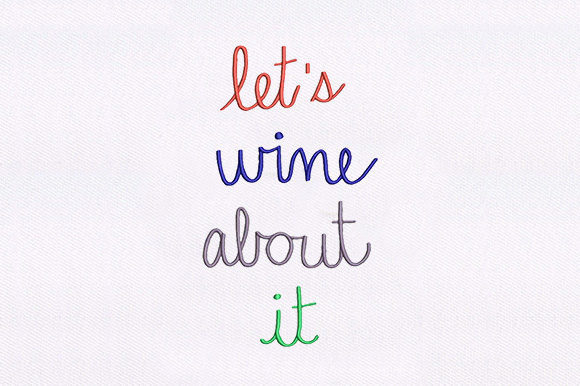
Lets Wine About It
A Designer’s First Glance: Playful, Polished, and Purpose-Built
When I opened Lets Wine About It in my embroidery software, I didn’t just see a wine-themed machine embroidery design—I saw intention. The layout is clean and balanced within the 5×7 hoop (3.74" × 6.81"), with generous negative space around the phrase and subtle vine accents framing the text without crowding it. It’s not overly ornate, but it’s not minimal either—it lands right where most craft businesses need it: confident enough for boutique branding, friendly enough for personalized gifts. The letterforms have gentle curves and consistent stroke weight—no fragile serifs or thin connectors that’ll vanish on knit fabric. That tells me this was digitized with real-world wear in mind.
How It Stitches in Real Projects—Not Just on Screen
I tested Lets Wine About It on three very different items: a medium-weight cotton tote bag, a midweight fleece-lined sweatshirt, and a soft linen tea towel. On the tote, it stitched cleanly with standard cutaway stabilizer—no puckering, no thread breaks. The satin stitch edges held crisp definition, and the fill stitch density (7,375 stitches total) felt substantial without being heavy or stiff. On the sweatshirt, I swapped to tear-away + light fusible, and again—no distortion. The height (6.81") gave plenty of breathing room on the chest or back placement, and customers consistently comment that “it looks custom, not clip-art.”
Where it shines brightest is in small-batch handmade products: embroidered baby onesies (use lightweight tear-away and slow your speed), kitchen towels for holiday gifting, and even iron-on patches for aprons or denim jackets. As an Etsy seller myself, I’ve used Lets Wine About It as both a standalone design and a base layer beneath a monogram or date—its open composition makes layering intuitive, not cluttered.
Where to Use It Thoughtfully—Not Everywhere
This isn’t a one-size-fits-all embroidery file—and that’s a good thing. Its 5×7 footprint means it won’t scale down cleanly into a 4×4 hoop without losing legibility, especially in the “Wine” portion. Avoid using it on highly textured fabrics like bouclé or thick terry cloth unless you add extra stabilizer and reduce top tension. On stretchy knits (think ribbed baby bodysuits or performance tees), test first with basting stitches and consider shortening jump stitches in your editing software.
Dark fabrics demand attention: the design relies on contrast, so if you’re stitching black thread on navy, the subtlety of the vine details may soften. I recommend testing a black-and-white mockup before finalizing digital previews for your shop. And while the stitch density is moderate—not dense enough to crack on repeated washing—it’s still wise to avoid placing it directly over seams or curved surfaces like cap fronts without re-hooping and careful alignment.
What It Adds to Your Finished Product—Beyond the Thread
Lets Wine About It elevates perceived value instantly. A plain canvas tote becomes a curated gift. A generic sweatshirt reads as intentional, not incidental. That matters for customer trust—especially when selling personalized gifts or boutique merchandise. Buyers recognize craftsmanship in clarity: clean letter edges, even spacing, and thoughtful negative space. This design delivers that without requiring advanced digitizing skills from *you*.
For craft business owners, it supports brand consistency across product lines—same tone on a pillow cover, same warmth on a holiday tea towel bundle. It also performs well in printable mockups: the proportions translate cleanly to flat-lay photography, and the shape works equally well centered or offset. No awkward cropping needed.
Practical Designer Notes You’ll Actually Use
- Always test on scrap fabric first—especially if you’re pairing it with a new stabilizer combo or unusual thread brand.
- Review stitch density in your software: at 7,375 stitches, it’s efficient for production but double-check jump stitch count if you’re optimizing for speed.
- Confirm hoop size compatibility: this is strictly a 5×7 design—don’t force it into smaller hoops without professional rescaling.
- Inspect small details at 200% zoom: the vine tendrils are delicate but digitized with enough underlay to hold on lightweight cotton.
- Try it in high-contrast thread colors—navy on cream, burgundy on natural linen, or metallic gold on charcoal—to maximize recognition and gift appeal.
- Use proper stabilizer for your fabric type: cutaway for knits, tear-away for stable wovens, and fusible + tear-away for nap-free texture like brushed cotton.
- Verify licensing before commercial use: since this is marketed as a machine embroidery design for real project use, confirm whether resale of finished items or digital redistribution is permitted.
Who This Design Is Really For—And Who It’s Not
Lets Wine About It is ideal for designers who want a polished, ready-to-stitch wine-themed embroidery file that doesn’t scream “clip art.” It suits Etsy sellers launching a summer gift collection, small shop owners updating their café apron line, or craft fair vendors building a cohesive set of kitchen and lifestyle goods. It’s also strong for personalized baby gifts (“Let’s Wine About It… and the Baby Shower”) or wedding weekend bundles—just pair it with neutral thread and quality fabric.
It’s less suited for ultra-minimalist brands, micro-embroidery projects (like cufflinks or tiny collar accents), or designs needing aggressive scalability. If you need a version that fits a 4×4 hoop or requires extensive customization (like adding a grape cluster icon or changing font weight), plan for minor digitizing tweaks—or contact the designer for alternate sizes.
Final Thought: A Reliable, Human-Centered Design Asset
As someone who’s stitched hundreds of embroidery files for client work and my own craft business, I judge Lets Wine About It not by how many formats it comes in (though having PES, DST, JEF, and VIP is helpful), but by how quietly it does its job. It stitches reliably. It reads clearly at arm’s length. It feels handmade—not mass-produced. And it gives buyers a little smile, not just a logo.
That’s the mark of a truly useful embroidery file: it disappears into the product, making the *maker* look skilled and the *recipient* feel seen. Lets Wine About It earns its place in my active design assets folder—not as filler, but as a go-to for thoughtful, sale-ready embroidery projects.